Restaurant allergen management software automates the process of identifying, documenting, and tracking allergens throughout menu items by analyzing ingredient data, flagging allergen-containing components, and synchronizing allergen information across all operational systems. These platforms use ingredient databases, recipe management tools, and intelligent algorithms to eliminate manual allergen tagging while reducing human error from 8-12% down to less than 2%.
The traditional approach to allergen management—spreadsheets, manual tagging, and institutional knowledge—creates dangerous vulnerabilities. A chef forgets to update allergen tags when substituting ingredients. A new supplier's formulation contains undisclosed allergens. A server misremembers which items contain dairy. Each vulnerability represents potential customer harm and legal liability.
Automated allergen management software eliminates these risks by creating systematic, technology-driven processes that track allergens from supplier invoice through customer plate. This article examines how automation works, evaluates essential software features, and provides guidance for selecting and implementing the right solution for your restaurant.
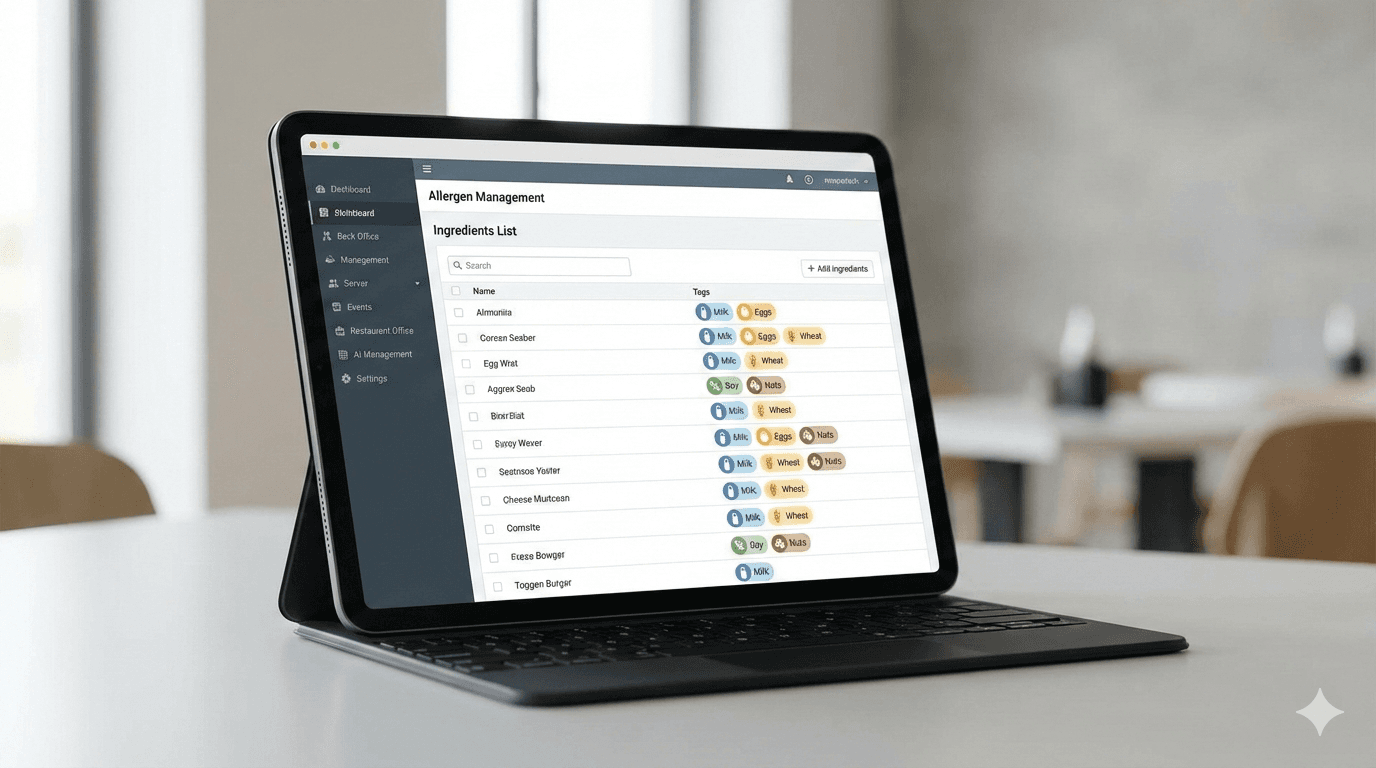
How Automated Allergen Identification Works
Ingredient-Level Intelligence
The foundation of automated allergen management is comprehensive ingredient intelligence. Advanced platforms maintain databases containing:
- Tens of thousands of ingredients with pre-tagged allergen profiles
- Supplier-specific data reflecting actual products you purchase, not generic ingredients
- Derivative identification that recognizes whey as dairy, albumin as egg, and other non-obvious allergen sources
- Cross-contact flags identifying ingredients processed on shared equipment
When you add an ingredient to a recipe, the software instantly identifies applicable allergens without requiring manual research or tagging.
Recipe-Based Allergen Calculation
Rather than tagging finished menu items manually, automated systems calculate allergens based on recipe composition:
- Build recipes by listing ingredients with quantities
- Software analyzes each ingredient's allergen profile
- System aggregates all allergens present in the final dish
- Platform generates allergen tags automatically for the menu item
When you modify a recipe—adding a new garnish, substituting an ingredient, or changing a sauce—the software recalculates allergens automatically and updates all customer-facing information within minutes.
Supplier Integration and Documentation
Leading platforms integrate directly with supplier systems to:
- Import ingredient specifications and allergen statements automatically
- Flag when suppliers update formulations or allergen disclosures
- Track "may contain" warnings from supplier packaging
- Maintain audit trails of ingredient sourcing for compliance documentation
Real-Time Synchronization
Once allergens are identified, automation extends to distribution:
- POS systems receive allergen data for server reference
- Digital menus update across all platforms simultaneously
- Kitchen display systems show allergen warnings on relevant orders
- Online ordering platforms display current allergen information
- Printed menu generation includes updated allergen tags
A single update propagates across your entire operation, ensuring consistency and eliminating the possibility of outdated information on any platform.
Essential Software Features for Allergen Management
Comprehensive Ingredient Database
What to look for: Pre-populated databases containing 10,000+ common restaurant ingredients with verified allergen profiles. The database should include brand-specific products from major suppliers (Sysco, US Foods, Gordon Food Service).
Why it matters: Starting with a robust ingredient database dramatically reduces setup time and ensures accuracy from day one.
Red flags: Platforms requiring you to manually enter allergen data for every ingredient essentially eliminate the automation benefit.
Recipe Management and Costing
What to look for: Intuitive recipe builders that calculate not just allergens but also costs, nutritional information, and prep instructions. Nested recipe support (sauces used in multiple dishes) ensures consistency.
Why it matters: Recipe management serves as the central hub for all menu data. A weak recipe tool undermines the entire platform.
Advanced capabilities: Version control for recipe changes, scaling tools for different serving sizes, and yield management for prep planning.
Supplier Connectivity
What to look for: Direct integrations or upload capabilities for supplier invoices and ingredient specifications. Automated alerts when supplier formulations change.
Why it matters: Supplier changes represent the highest risk for unexpected allergen introduction. Automated tracking catches these changes before they reach customers.
Questions to ask vendors: Which suppliers do you integrate with directly? How do you handle custom or local suppliers?
Multi-Platform Distribution
What to look for: API connections that push allergen data to your POS, website, mobile app, digital menu boards, and third-party platforms (DoorDash, Uber Eats, Grubhub).
Why it matters: Manual data entry to multiple platforms wastes time and introduces errors. Automated distribution ensures perfect consistency.
Critical requirement: Real-time or near-real-time synchronization (updates propagating within 5-10 minutes maximum).
Cross-Contact Management
What to look for: Tools for documenting shared equipment, flagging high-risk preparation methods, and generating kitchen warnings for allergen-sensitive orders.
Why it matters: Proper allergen disclosure extends beyond ingredients to preparation methods. Many reactions occur from cross-contact despite accurate ingredient tagging.
Advanced capabilities: Integration with kitchen display systems that highlight allergen warnings in bold or color-coded displays.

Quantified Benefits of Automation
Time Savings
Manual allergen management consumes significant labor hours:
Traditional Manual Approach
- Recipe documentation: 15-20 min per item
- Allergen research and tagging: 10-15 min per item
- Updates when recipes change: 10-15 min per change
- Distribution to all platforms: 20-30 min per update
50-item menu: 20-30 hours initial setup
Automated Approach
- Recipe documentation: 10-15 min per item (includes allergen calculation)
- Allergen tagging: Automatic (0 minutes)
- Updates: 2-3 min for recipe modification
- Distribution: Automatic (0 minutes)
50-item menu: 8-12 hours initial setup
Annual time savings: For restaurants updating menus monthly, automation saves 40-60 hours annually
Worth $1,000-$1,500 in labor costs
Error Reduction
Human error in allergen management carries severe consequences:
Manual Error Rates
8-12%
of allergen tags contain errors
Automated Error Rates
<2%
typically from initial data entry
Risk Reduction
75-85%
decrease in tagging errors
Financial impact: Each allergen-related incident averages $15,000-$75,000 in medical costs, legal fees, and settlements. Preventing even one incident annually justifies software investment.
Evaluating Software Solutions: Selection Criteria
For Independent Restaurants (1-3 locations)
Priority features: Intuitive interface requiring minimal training, affordable pricing ($50-$200 monthly), integration with common POS systems, good customer support.
Recommended platforms: MarketMan, Galley Solutions, meez
Budget: $600-$2,400 annually, typically recovering costs through reduced waste and improved efficiency within 6-12 months.
For Restaurant Groups (4-20 locations)
Priority features: Multi-location management from single dashboard, centralized menu control with location-specific variations, robust supplier integration, comprehensive reporting.
Recommended platforms: BlueCart, Craftable, Optimum Control
Budget: $200-$800 monthly per location (often with volume discounts), justified by consistency across locations and reduced liability.
For Large Chains (20+ locations)
Priority features: Enterprise-grade scalability, advanced API capabilities for custom integrations, role-based permissions and approval workflows, dedicated account management.
Recommended platforms: MarginEdge, Restaurant365, Crunchtime
Budget: $1,000-$5,000+ monthly, negotiated based on location count and feature requirements.
Implementation Timeline and Best Practices
Phase 1: Data Migration (Weeks 1-2)
- Import existing recipes and ingredient lists
- Verify allergen tags on high-risk items
- Connect supplier accounts for automatic data feeds
- Configure POS and website integrations
Phase 2: Team Training (Weeks 2-3)
- Train kitchen managers on recipe entry and updates
- Educate servers on accessing allergen information in POS
- Develop protocols for handling recipe modifications
- Establish approval workflows for menu changes
Phase 3: Soft Launch (Week 4)
- Test system with limited menu sections
- Monitor for errors or inconsistencies
- Gather staff feedback on usability
- Refine workflows based on real-world usage
Phase 4: Full Deployment (Week 5+)
- Roll out complete menu
- Monitor system performance
- Conduct monthly data audits
- Establish ongoing maintenance procedures
Return on Investment Calculation
Typical Costs
Independent Restaurants
$1,200-$4,800/year
Small Chains
$5,000-$20,000/year
Quantified Benefits
Labor Savings
$1,000-$3,000/year
Waste Reduction
$2,000-$5,000/year
Risk Mitigation
$15,000-$75,000+
avoided cost per incident
Payback Period
6-18 months
for most operations, with ongoing annual savings thereafter
Conclusion: Automation as Risk Management
Restaurant allergen management software represents more than operational convenience—it's essential risk management infrastructure for modern food service. The modest investment in automation yields measurable returns through time savings and waste reduction while providing immeasurable protection against the catastrophic costs of allergen-related incidents.
As regulatory requirements intensify and customer expectations for transparency grow, manual allergen management becomes increasingly untenable. Restaurants that embrace automated solutions position themselves as safety-conscious, technologically advanced operations that prioritize customer wellbeing alongside profitability.
Next in this series: Discover how centralized menu and inventory data reduces food waste while improving sustainability and profitability.
Read: How to Reduce Food Waste with Centralized Menu & Inventory Data